Emergency Tree Service for Dangerous Leaning Trees
On a windy afternoon in Valrico, a homeowner notices their large laurel oak suddenly leaning closer to the roofline. The driveway is beneath it, kids play in the yard, and a storm front is rolling in from Tampa Bay. Do they wait and see if it holds—or call for help right away?
Across Hillsborough County, leaning trees are one of the most common reasons people request emergency tree service. According to FEMA, falling trees and limbs are a major cause of property damage during severe weather, especially in hurricane‑prone states like Florida. In a community filled with mature oaks, pines, and ornamental trees, understanding when a lean is dangerous can protect both people and property.
This guide explains how to recognize a hazardous lean, what to do in an emergency, and how professional arborists handle these situations safely. You’ll learn warning signs to watch for, how emergency response works, what it typically costs in our area, and how proactive Tree Trimming and maintenance can prevent future emergencies.
Key Insight: Dangerous leaning trees rarely “fix themselves.” Fast, professional assessment and action can be the difference between a controlled removal and a catastrophic failure.
How to Tell if a Leaning Tree Is Truly Dangerous
Not every leaning tree is an emergency. Some species naturally grow at an angle, especially when reaching for sunlight. The real concern is sudden or progressive change—a tree that recently started leaning more, or one that shows signs of structural failure.
Key warning signs of a hazardous lean
Look for these red flags around your Valrico property:
- Fresh cracks in the soil on the side opposite the lean
- Heaving or raised soil around the base of the tree
- Exposed roots or roots lifting out of the ground
- Cracks in the trunk, especially on the tension side
- Bark splitting or new fissures after a storm
- Doors or fences nearby suddenly misaligned
If you notice a new lean after heavy rain or wind, that tree may have lost root support. In our sandy Florida soils—with frequent saturation from summer storms—root plates can fail surprisingly fast.
“Any tree that suddenly leans more than it did last week deserves an immediate professional inspection.” — ISA Certified Arborist
Local example: The overnight lean in a Valrico cul‑de‑sac
Timber Kings Tree Service was called to a Valrico cul‑de‑sac after a homeowner noticed their 40‑foot water oak leaning noticeably toward the street overnight. The soil was saturated from days of rain, and the base of the trunk showed fresh heaving.
Our team performed a rapid tree health assessment, found a compromised root system, and recommended emergency Hazardous Tree Removal the same day. By that evening, the tree was safely removed, and traffic in the cul‑de‑sac was restored.
When in doubt, assume a new lean is unsafe until a professional confirms otherwise. That mindset protects your family and your neighbors.
Why Leaning Trees Are So Risky in Florida’s Storm Climate
Leaning trees and Gulf Coast weather are a bad mix. Valrico sits in a region where tropical storms, afternoon thunderstorms, and occasional hurricanes can bring high winds and saturated soils multiple times a year.
How weather makes leaning trees more dangerous
- High winds increase leverage on an already compromised root system.
- Soaked soil reduces friction holding roots in place, especially in our sandy loam.
- Repeated storms weaken stressed trees over time, even if they “survive” each event.
A lean that seems stable on a calm day can fail suddenly in a 40–60 mph gust—common in summer thunderstorms.
According to the Insurance Information Institute, fallen trees and limbs are a leading source of storm‑related property claims. Many of these incidents involve trees with pre‑existing lean or decay that went unaddressed.
Valrico case: Storm‑damaged pine over a driveway
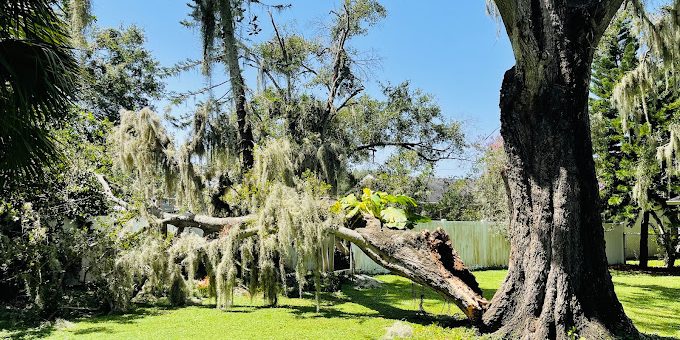
After a strong line of storms moved through eastern Hillsborough County, one Valrico homeowner noticed their tall pine now leaning over the driveway, with the root plate slightly lifted on one side. They initially planned to “watch it for a while,” but a neighbor urged them to call Timber Kings.
Our Storm Damage crew found extensive root damage and a hollow section at the base. We used a crane to safely remove the tree in sections. Two days later, another storm hit the area with 50+ mph gusts. Had that tree remained, it likely would have come down across the driveway—and possibly onto the family’s vehicles.
“The combination of pre‑existing tree defects and storm conditions is what turns a leaning tree into a high‑risk emergency.” — Timber Kings Lead Climber
Thoughtful maintenance, including periodic Tree Pruning and inspections, is the best defense. But when a storm accelerates a lean or exposes hidden damage, fast emergency response is critical.
What Happens During an Emergency Tree Service Call
Knowing what to expect during an emergency can reduce stress and help you make better decisions. A reputable company will follow a structured process focused on safety, assessment, and clear communication.
Step‑by‑step emergency response
When you call for Emergency Tree Service, here’s how Timber Kings typically responds:
1. Phone Triage
- Gather details: tree size, species (if known), what it’s leaning toward, visible damage, power lines.
- Ask for photos or video if safe to provide.
- Determine if it’s life‑safety critical or urgent but stable.
2. On‑Site Assessment
- ISA Certified Arborist or experienced crew leader evaluates:
- Root stability
- Trunk and canopy structure
- Targets (home, vehicles, utilities, play areas)
- Decide between stabilization, partial Tree Cutting, or full removal.
3. Safety Setup
- Establish exclusion zones.
- Coordinate with utilities if lines are involved.
- Set up rigging, cranes, or bucket trucks as needed.
4. Controlled Work
- Sectional removal from the top down when possible.
- Use of ropes and pulleys to guide limbs away from structures.
- Continuous communication between climbers and ground crew.
5. Cleanup and Next Steps
- Debris removal, optional Stump Grinding, and site cleanup.
- Recommendations for remaining trees and preventive care.
Real‑world example: Nighttime lean over a Valrico roof
One evening, a Valrico family heard cracking sounds during a thunderstorm. They looked outside and saw their large oak now leaning toward the roof, with limbs resting on the shingles. We dispatched our emergency crew with lighting, rigging gear, and a bucket truck.
By methodically removing weight from the canopy and using controlled lowering techniques, we prevented the trunk from shifting further. The family was able to sleep in their home that night, and the only damage was minor shingle scuffing, far less than if the tree had failed outright.
Removal vs. Repair: When a Leaning Tree Can Be Saved
Not every leaning tree must be cut down. The decision between removal and attempting to stabilize or correct the lean depends on safety, tree health, and long‑term viability.
Factors professionals consider
- Degree and speed of lean
A long‑standing gentle lean with no recent change is often manageable. A sudden or rapidly increasing lean usually isn’t.
- Root system condition
Uprooting, root rot, or severed roots from past construction greatly reduce salvage options.
- Target zone
A leaning tree over a playset, home, or neighbor’s property carries higher risk than one leaning over open yard.
- Species and structure
Some species tolerate corrective pruning or support systems better than others.
Options for borderline cases
- Crown reduction or crown thinning
Strategic Crown Reduction can reduce wind load and weight on the leaning side.
- Cabling and bracing
In select cases, professional support systems can stabilize multi‑stem trees or reduce the risk of failure.
- Monitoring with regular inspections
For trees that are currently stable but show potential issues, scheduled inspections and Tree Shaping may be recommended.
“We only recommend saving a leaning tree if we’re confident it can remain reasonably safe with proper care.” — Timber Kings ISA Certified Arborist
Local scenario: Saving a leaning live oak
In a Valrico neighborhood near Lithia Pinecrest Road, a mature live oak developed a modest lean toward the street after a construction project disturbed nearby soil. Instead of immediate removal, our arborist recommended a combination of crown thinning on the leaning side, root‑zone care, and monitoring.
Three years later, with proper Arborist Services, the tree remains healthy and stable, providing shade and curb appeal without presenting undue risk.
Still, when a lean is severe or the tree is decayed or hollow, dead tree removal or full Tree Removal is often the only responsible option—especially in dense residential areas.
Costs, Risks, and Benefits: Emergency Service vs. Waiting It Out
Property owners sometimes hesitate to call for emergency help, hoping a leaning tree will “hold” until a more convenient time. Understanding the tradeoffs can clarify that decision.
Cost and risk comparison
Below is a generalized comparison for the Valrico area (actual prices vary by tree size, access, and complexity):
| Scenario | Typical Approach | Relative Cost in Valrico | Risk Level to Property | Long‑Term Outcome |
|---|---|---|---|---|
| Sudden severe lean toward home | Immediate emergency removal | $$$ | Low (if addressed) | Home protected, predictable expense |
| Moderate lean over open yard | Scheduled removal within weeks | $$ | Moderate | Risk reduced before major storm season |
| Leaning tree left “as is” | No action | $ (short term) | High | Potential major damage, higher future costs |
| Stable lean, healthy tree | Pruning / monitoring | $–$$ | Low–Moderate | Tree retained with managed risk |
| Uprooted or cracked trunk | Urgent Fallen Tree Removal | $$$ | High (until done) | Emergency resolved, possible property loss |
Example: The “wait and see” that went wrong
A Valrico landlord noticed a large camphor tree leaning more each season toward a rental property’s carport. They postponed action due to cost concerns. During a summer storm, the tree failed, crushing the carport and damaging two vehicles.
The eventual bill—emergency Tree Removal Near Me, structural repairs, and insurance deductibles—far exceeded what proactive removal would have cost. The tenants also had to relocate temporarily, adding stress and potential liability.
In a region like Valrico, where severe weather is a yearly reality, the “wait and see” approach with a dangerous lean is often the most expensive option in the long run.
Beyond the Emergency: Cleanup, Stumps, and Future Prevention
Once the immediate hazard is removed, there’s still important work to finish the job safely and prepare your property for the future.
Dealing with stumps and roots
After a leaning tree is cut down, the remaining stump can:
- Attract pests like termites or carpenter ants
- Create a trip hazard in the yard
- Interfere with mowing and landscaping
- Sprout unwanted regrowth in some species
Professional Stump Grinding Near Me removes the stump below grade, allowing you to re‑sod, replant, or redesign the area. In Valrico neighborhoods with smaller lots, this is especially helpful for regaining usable yard space.
Brush clearing and land restoration
Emergency removals often leave a surprising amount of debris—logs, branches, and brush. Comprehensive brush clearing and Land Clearing Services can:
- Open up overgrown corners of your property
- Reduce fire load and pest harborage
- Improve visibility and security
For larger properties or commercial sites, forestry mulching can turn thick underbrush into usable, mulch‑covered ground in a single pass.
“The emergency may be over, but the way you handle cleanup can either restore your property—or leave lingering safety and maintenance problems.” — Timber Kings Operations Manager
Preventing the next emergency
Once the leaning tree is gone, consider a proactive plan:
- Schedule periodic Tree Health Assessment visits
- Address any remaining hazardous tree removal needs
- Use strategic Crown Thinning to reduce wind resistance
- Treat early tree disease or tree pest control issues before they weaken structure
This long‑term approach costs far less than repeated emergency calls and provides peace of mind through every storm season.
What This Means for Businesses in Valrico, FL
For businesses in Valrico—whether you operate along State Road 60, manage a small office park off Lithia Pinecrest, or oversee a multi‑building complex—dangerous leaning trees are more than a landscaping issue. They’re an operational and liability concern.
Operational and safety impacts
- Customer and employee safety
A leaning tree over a parking lot, sidewalk, or outdoor seating area can create serious risk. An injury from a falling limb can result in medical claims and legal exposure.
- Business interruption
A tree failure that blocks driveways, loading docks, or emergency access can halt operations. Even a few hours of downtime can be costly for restaurants, retail, and service businesses.
- Property and fleet damage
Commercial vehicles, HVAC units, signage, and roof structures are frequent targets when a leaning tree fails.
Why proactive management matters locally
In Valrico’s storm‑prone climate, commercial properties are especially vulnerable. Many sites have older landscaping where trees were planted too close to buildings or parking areas decades ago. As they mature, those same trees can develop leans or structural issues.
By partnering with a local tree care company for ongoing Commercial Tree Service, businesses can:
- Identify and address high‑risk trees before storm season
- Use targeted Crown Reduction and structural pruning to reduce failure risk
- Plan phased Tree Removal for declining trees rather than waiting for an emergency
- Maintain clear sightlines for signage and security cameras
For new developments or expansions, professional Lot Land Clearing ensures trees are removed or preserved correctly from the start, reducing the chance of future leaning or instability due to root damage.
Ultimately, addressing leaning trees proactively helps Valrico businesses protect their people, reputation, and bottom line—while keeping properties attractive and welcoming for customers.
Frequently Asked Questions
Q: How do I know if my leaning tree is an emergency or can wait for a regular appointment?
A: Consider three main factors: recent change, target, and visible damage. If the tree recently started leaning more, is over a home, driveway, or play area, or shows signs like cracked soil, exposed roots, or trunk splits, treat it as an emergency and call for Emergency Tree Service. In Valrico’s weather, a compromised tree can fail quickly during the next storm. If the lean is long‑standing, the tree appears healthy, and it’s not over anything valuable, a scheduled Tree Health Assessment may be sufficient. When in doubt, a quick professional look can prevent costly mistakes.
Q: Will my insurance cover emergency tree removal for a dangerous lean?
A: Coverage varies by policy, but many homeowner and commercial policies focus on damage that has already occurred—such as a tree that has fallen on a structure—rather than preventive Tree Removal. However, some insurers in Florida appreciate proactive risk reduction and may look favorably on documentation from a Certified Arborist recommending removal of a hazardous tree. It’s wise to contact your agent, share photos, and request clarification before and after the work. Timber Kings can provide detailed invoices and reports describing the hazard, which can support any potential claim or future underwriting discussions.
Q: Can a leaning tree be straightened instead of removed?
A: In limited cases—typically smaller, recently planted trees with minor lean—professionals can sometimes correct the lean with staking, guying, and careful Tree Shaping. For mature trees, especially those common in Valrico like large oaks and pines, straightening is usually not safe or effective. Once a big tree has developed a significant lean, its root system and internal structure have adapted, and forcing it upright can cause further damage or sudden failure. In those cases, options include targeted pruning, support systems, or full Hazardous Tree Removal if the risk is too high.
Q: How much does emergency removal of a leaning tree typically cost in Valrico?
A: Costs depend on tree size, location, access, and complexity. A small to medium tree in an open yard is far less than a large oak over a home requiring cranes and advanced rigging. Emergency work after storms, at night, or involving power lines also tends to cost more. While it’s impossible to give a one‑size number, our Valrico customers often find that addressing a dangerous lean promptly avoids larger expenses from property damage, Fallen Tree Removal, and structural repairs. We provide clear, written estimates on site and can discuss options like combining services with Stump Grinding to maximize value.
Q: How quickly can you respond to an emergency leaning tree in Valrico?
A: Response time depends on current call volume and weather conditions, but Timber Kings prioritizes situations where life safety or major property damage is at immediate risk. In many Valrico neighborhoods, we can arrive the same day—often within hours. During large storm events, we triage calls based on severity: trees on structures, blocking access, or threatening power lines are handled first. Our crews are equipped for both daytime and nighttime operations, with lighting and specialized gear to safely manage Storm Damage and unstable trees.
Q: After removing a dangerous leaning tree, should I plant another tree in the same spot?
A: Often, yes—but with planning. Removing a large tree changes light, wind, and soil conditions. In Valrico’s climate, it’s smart to choose wind‑resistant species and plant them a safe distance from structures, driveways, and utilities. Avoid replanting directly on top of the old root system; instead, consider shifting the planting site slightly and having the old stump professionally removed with Stump Removal. Our arborists can recommend species and placement that balance shade, aesthetics, and long‑term safety, so you enjoy the benefits of trees without repeating the same risk.
Q: What can I do to prevent my trees from becoming dangerous leaners in the future?
A: Prevention starts with proper pruning, planting, and monitoring. Regular Tree Trimming Near Me by trained professionals encourages strong structure and reduces wind resistance. Plant new trees at the right depth, with enough space from structures and each other. Avoid cutting major roots during construction or landscaping. In Valrico, scheduling periodic Tree Care Services—including inspections for decay, pests, and soil issues—helps identify concerns before they lead to leaning or failure. A modest investment in proactive care often saves thousands in emergency work and property repairs down the road.
Ready to Get Started?
Dangerous leaning trees rarely give second chances—especially in a storm‑prone area like Valrico. If you’re seeing new cracks in the soil, a tree suddenly closer to your roofline, or branches sagging over driveways and play areas, this is the time to act, not after the next storm passes through.
Timber Kings Tree Service offers fast, professional Emergency Tree Service, backed by certified arborists, modern equipment, and deep experience with Florida’s trees and weather patterns. Whether you need immediate help with a hazardous lean or want a thorough assessment of your property’s trees, our team can guide you through every step—from evaluation and Tree Removal Near Me to cleanup and Stump Grinding.
Reach out today to schedule an inspection or request urgent assistance. A short conversation now can prevent costly damage, protect your family or business, and restore peace of mind before the next storm rolls across Hillsborough County.
About Timber Kings Tree Service
Timber Kings Tree Service is a locally owned and operated tree care company serving Valrico, FL, and surrounding communities. Our team includes ISA Certified Arborists and experienced climbers specializing in Residential Tree Service and Commercial Tree Service, from routine Tree Care Services to complex Storm DamageContact Timber Kings Tree Service