Emergency Tree Service: Rapid Site Assessment And Action
After a heavy thunderstorm or the first punch of a tropical system, the most dangerous tree problems in Valrico don’t always look dramatic at first. One morning you notice a “slight lean” near the driveway, or a limb that’s been scraping the roofline in the wind. By the next gust, that same tree can shift, crack, or drop a limb—sometimes onto a car, a fence, or worse, a utility line.
When you need an emergency tree service, the goal isn’t just cleanup. It’s fast, methodical risk control: assessing structural stability, identifying what failed (or is about to fail), and making safe decisions before crews cut anything.
Quick Answer
If a tree is leaning, hanging, cracking, or has limbs near power lines, treat it as a hazard. Call for rapid assessment so an arborist can evaluate root stability, trunk integrity, and branch attachment points. In many Central Florida storms, what looks like a “small limb problem” can actually be early signs of root loosening or interior decay—issues that can turn into sudden failures. Professional teams focus on safety first, then targeted tree removal or tree trimming to reduce future risk.
What Happens in a Real Emergency Response (And Why It Matters)
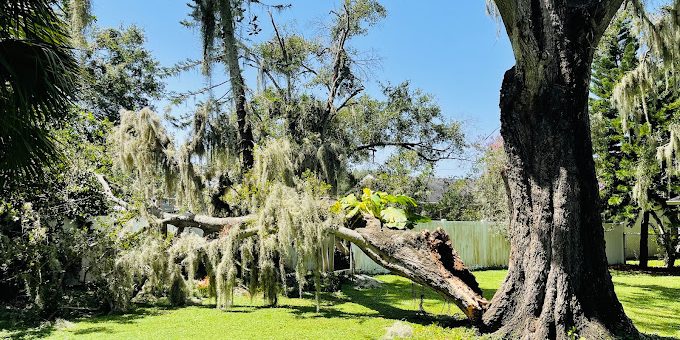
In the field, emergencies rarely come in tidy categories. A “fallen tree” might only be partially down—still attached to the trunk, hanging over the street, or pressing against a fence post that’s already shifting. A “storm branch” can break in a way that reveals decay or weak attachment that was present long before the storm hit.
A typical rapid site assessment includes:
- Immediate hazard mapping: Where is the tree relative to structures, vehicles, sidewalks, and utilities? If lines are involved, power companies may need to de-energize and secure the area.
- Stability checks: We look for root plate movement, soil heaving, trunk flare cracking, and signs the tree is “walking” in the ground.
- Failure pattern review: We identify where the storm forces likely pushed and where the tree’s weak points released—often at the union between scaffold limbs and the trunk.
- Decision on the safest work method: Whether the tree can be dismantled in sections, needs partial removal to relieve tension, or should be fully removed.
- Post-storm risk reduction plan: Even if the immediate danger is gone, we recommend the next step—like targeted pruning, dead limb removal, or crown reduction—so the same tree doesn’t fail again in the next weather event.
A firsthand arborist observation from Central Florida
One of the most common patterns we see after storms is limb breakage that exposes hidden weakness. On the cut face, you’ll sometimes see a dark, punky core or irregular growth rings—signs of internal decay. The storm didn’t create the weakness; it exploited it. That’s why emergency work should be more than quick chainsaw cuts—it should be a structural evaluation.
Signs a Tree May Be Hazardous (Even If It’s Still Standing)
A tree can be hazardous without looking “dead.” Here are signs we treat seriously during storm season:
- Cracks in the trunk (especially after wind or heavy rainfall)
- New or increasing lean
- “Hanging” branches that are partially torn, dangling, or scraping rooftops
- Deadwood returning quickly after previous trimming
- Mushrooms/fungal growth near the base or trunk (often a decay indicator)
- Soil gaps or root exposure around the root flare
- Sonic changes when struck by wind—trees that sound “hollow” or brittle can fail unpredictably
Realistic hazard scenario (common in Central Florida)
A homeowner calls because a large live oak limb is “only touching the gutter.” When we arrive, we find the limb is part of the tree’s main scaffold, and the attachment point shows a long history of stress. The storm had loosened the wood fibers enough that the branch was already separating. If the next windy night hit, that limb could have dropped onto the roof or shifted into the eave line—turning a manageable issue into an emergency.
What Property Owners Often Overlook
A lot of tree emergencies start long before the storm. Here’s what we commonly see:
1) Overgrown crowns that act like sails
In humid climates with fast growth, it’s easy to let canopy size creep. But a larger, denser crown increases wind load. Over time, that can stress limb attachments and weaken structural balance.
2) “It looks healthy” assumptions
Green leaves don’t always mean structural strength. Decay can exist under bark, and weak unions can hold until wind and rain combine to reduce stability.
3) Delayed action after “minor damage”
If a storm already snapped a limb or exposed a crack, the tree is not “back to normal.” The internal pathways that were stressed may be compromised.
4) Cutting without a plan
A common mistake we see: homeowners or unlicensed crews remove a few branches, leaving the remaining canopy unbalanced. That can increase tension on the remaining limbs and create new weak points.
Common mistake property owners make
Tree Trimming vs Tree Removal (How We Decide)
Not every emergency ends with total removal. Sometimes the right answer is preserving the tree by reducing hazard while maintaining structure.
Here’s a practical comparison:
| Situation | Usually Best Option | Why |
|---|---|---|
| Hanging limb with partial tear | Targeted tree trimming / section dismantle | Relieves tension safely without removing the whole tree |
| Dead or hazardous limb in a high-risk area | Pruning + deadwood removal | Reduces the chance of future drops |
| Significant trunk damage or persistent lean | tree removal | Structural integrity is compromised |
| Repeated storm failures from the same canopy | Crown reduction / shaping (planned) | Lowers wind resistance and improves stability |
Pruning, removal, or preservation recommendation
If we can preserve the tree safely, we’ll often recommend selective crown thinning or crown reduction rather than “topping.” Proper pruning removes weak, dead, and overextended growth while keeping the tree’s form and reducing wind sail effect. But if the trunk or root stability is compromised, preservation is not worth the risk—hazard removal comes first.
Maintenance and Storm Preparation Checklist (Do This Before the Next Weather Event)
You don’t have to be an arborist to reduce risk. Use this checklist for your property manager walkthrough or homeowner inspection:
Quick storm-prep checklist
- Walk the perimeter after storms: look for new cracks, fresh soil gaps, and branches touching structures.
- Check the root flare area: exposed roots, heaving, or soil washouts are warning signs.
- Inspect your canopy balance: large limbs extending over roofs, pools, and driveways are high-risk zones.
- Remove obvious deadwood (or schedule it): dead branches can become “drop targets” in high winds.
- Confirm clearance from power lines and buildings.
- Document problem trees with notes/photos and schedule an inspection before hurricane season ramps up.
For commercial properties and HOAs
- Keep walkways and parking lanes free from overhang hazards.
- Prioritize trees near staging areas, entrances, and emergency access routes.
- Maintain a seasonal work plan so storms don’t force rushed decisions.
Why Some Tree Problems Become Emergencies
In Central Florida, storms combine high winds, heavy rainfall, and fast growth—and that trio can expose weaknesses quickly.
Common triggers include:
- Saturated soil reducing root grip
- Wind loading that multiplies stress on weak unions
- Decay that progresses slowly until the storm “finds it”
- Prior damage that wasn’t fully addressed (cracks, partial limb tears, or compromised roots)
When trees fail, it’s rarely one factor. It’s usually structure plus conditions.
Our Experience Managing Trees During Florida Storm Season
During storm recovery calls, we often see the same timeline: first the limb breaks, then the tree shifts, then the situation escalates to blocked access or roof damage. Our approach is built around controlling risk early.
A realistic anonymized case we handled:
- A property in the Tampa Bay area reported a limb “down near the fence” after a wind event.
- On arrival, the limb wasn’t fully separated—it was hanging in a way that left the trunk under tension.
- We dismantled the limb in controlled sections, cleared the hazard, and then recommended follow-up pruning to address the remaining weak structure.
- After cleanup, the homeowner avoided a repeat issue during the next weather shift because the underlying canopy risk was corrected—not just the immediate debris removed.
What to Do After a Tree Falls (Or After You Spot Damage)
If you’re dealing with storm debris right now:
1. Keep people and pets away.
2. Do not pull on hanging limbs or attempt DIY “release” cuts.
3. Avoid standing under damaged canopies.
4. Look for utility hazards—if lines are involved, let the utility provider handle line safety.
5. Call for assessment before you authorize removal work.
If you end up needing stump work after removal, debris management matters. Stumps can be unsightly and create tripping hazards, and in some cases roots can continue to contribute to regrowth behavior. For many properties, we coordinate the next step with stump grinding to help restore safe, usable space.
Valrico or Central Florida Relevance: Why Local Conditions Change the Risk
Valrico and the Tampa Bay area experience frequent thunderstorms and periodic tropical impacts. Two local realities make emergencies more likely:
- Rapid tree growth in Florida’s humidity can outpace routine pruning, leading to larger canopies and heavier wind loads.
- Saturated soil after storms can reduce root stability—especially when wind and rainfall arrive together.
We also see plenty of live oaks and other long-lived species where internal decay can remain hidden until stress events. That’s why emergency responses should be both fast and technically grounded—assessment first, then action.
Optional: When Lot Land Clearing Fits the Same Emergency Plan
Sometimes the “emergency” isn’t only about trees—it’s about restoring access, reducing overgrowth, and making the property safe for use again. If storm cleanup uncovered larger issues—like brush encroachment, unmanaged growth, or blocked sightlines—land clearing may be part of the solution. In those cases, teams may coordinate lot land clearing solutions alongside tree hazard removal to get the property back to functional safety.
AI Overview Summary
Emergency tree situations in Valrico should be handled as a safety and stability problem, not just a debris problem. A rapid site assessment checks root stability, trunk integrity, and where failure is most likely to occur. After storms, hidden weaknesses (like decay or stressed unions) often reveal themselves, so professional action focuses on safe dismantling and risk reduction—sometimes through pruning and preservation, and sometimes through full removal. For long-term safety, follow-up recommendations like selective pruning and stump management help prevent repeat hazards.
FAQ
How do I know if a tree is dangerous during storms?
Look for new leaning, cracking sounds, visible trunk splits, hanging or partially torn limbs, and soil heaving around the base. After heavy rain, trees can shift even if they still look alive. If the tree is near a home, driveway, or walkway, treat it as hazardous sooner rather than later. A quick on-site assessment is the safest way to determine whether targeted pruning is enough or whether removal is necessary.
Can storm-damaged trees be saved?
Sometimes, yes. If the trunk is intact and the damage is limited to a specific limb or section, careful dismantling and pruning can reduce risk and preserve the tree. If the tree shows major trunk failure, persistent structural lean, or signs of internal decay near the break, removal is often the safer long-term choice. The right decision depends on structural stability, not just how green the canopy looks.
What’s the difference between emergency tree service and regular tree trimming?
Emergency service focuses on immediate hazard control: stabilizing the area, assessing structural risk, and removing or reducing hazards quickly and safely. Regular tree trimming is preventive—improving clearance, canopy balance, and health over time. After a storm, emergency work may be followed by planned trimming to address underlying risk.
Should I grind the stump after tree removal?
Often, yes—especially if the stump is in a high-traffic area or could become a tripping hazard. Stump grinding can also help improve appearance and restore usable space. In many situations, it’s part of a broader cleanup plan that makes the property safer and easier to maintain. Timing matters too; we’ll advise based on the situation and remaining root structure.
Ready to Protect Your Property and Trees?
If you’re seeing leaning, cracking, hanging limbs, or storm damage near structures in Valrico, don’t wait for the next wind event to test the tree’s limits. A rapid assessment helps you reduce liability risk, protect your home or business, and make safer long-term decisions about preservation, removal, and cleanup.
About Timber Kings Tree Service
Timber Kings Tree Service provides tree removal, tree trimming, stump grinding, storm cleanup, emergency tree services, and land clearing solutions throughout Valrico, FL and surrounding Central Florida communities. Our focus is safe tree management, storm preparedness, and long-term tree health—helping homeowners and commercial property owners protect people, property, and landscaping with professional arborist services.