Tree Removal Planning: Clear, Safe, and Efficient
After a heavy thunderstorm in Valrico, you might notice a “minor” problem that isn’t minor at all—an oak limb that’s hanging by a few strands, a tree leaning toward the roofline, or a trunk that’s shifted after saturated ground. The danger usually comes from what you can’t see: cracked wood, loosened roots, and internal decay that only becomes obvious when wind and rain push a tree beyond its limits.
Planning tree removal isn’t just about cutting a tree down. It’s about protecting people, structures, utilities, and your remaining landscape—while keeping the job controlled and efficient. At Timber Kings Tree Service, we plan each removal like a small engineering project, because in Central Florida, storms can turn a “watch it later” situation into an urgent liability overnight.
Quick Answer
Tree removal planning means assessing the tree’s structure and health, checking for hazards (roots, decay, power lines, nearby buildings), and choosing the safest method to remove it. In Valrico and the Tampa Bay area, we also consider storm-driven conditions—like wind exposure and saturated soil—that can make trees fail unexpectedly. A professional arborist will recommend preservation (when possible), or targeted removal (when necessary), plus cleanup options such as stump grinding or hauling.
Signs a Tree May Be Hazardous
Not every removal is obvious. Many hazardous trees look “fine” until conditions change. Here are common red flags we see during site inspections:
- Leaning or “new” movement after storms
- Cracks in the trunk or visible splits near major limbs
- Fungal growth at the base (mushrooms, bracket fungi) or along wounds
- Deadwood concentrated in one side of the canopy
- Soil heaving or exposed roots after heavy rain
- Girdling roots (sometimes visible as surface roots that circle or press into structures)
- Large limbs over roofs, driveways, or walkways
- Crown dieback (declining leaf density) paired with poor vigor
Common homeowner hazard scenario (realistic)
A customer we assisted with a residential property had a large live oak shading the front yard. After a wet, windy day, a limb “settled” lower and began brushing the gutter. The homeowner avoided touching it, assuming it would stay put. When we inspected, we found a combination of structural stress and weak attachment from years of storm cycling—plus interior compromise that didn’t show on the outside. The limb removal plan included controlled rigging to protect the roof edge and landscaping during extraction.
What Property Owners Often Overlook
Most tree failures start with conditions that build quietly. The common mistakes we hear about (and see in the field) include:
- Waiting too long because the tree “hasn’t fallen yet.” A tree can become progressively unstable and still remain upright until a specific wind/rain pattern hits.
- Assuming that green leaves mean the tree is healthy. Some trees show leaf-out while still having internal decay or compromised support.
- Cutting without a plan. Improper “DIY tree cutting” can create unpredictable drops, swing hazards, and damage to nearby structures.
- Ignoring the root zone. In Central Florida’s wet periods, roots may already be weakened—then storms expose the failure point.
- Forgetting about clearance and access. Even if a tree is “safe to cut,” it may be unsafe to remove if there’s no room for equipment, rigging, or safe staging.
What Actually Improves Tree Stability
A tree’s stability isn’t just about the trunk—it’s about the whole system: roots, structure, and canopy balance. The right approach depends on what’s failing.
Pruning vs. removal (a practical distinction)
- Tree trimming / tree pruning is often used to improve structure and reduce risk by removing deadwood, correcting poor form, and lightening heavy, wind-exposed sections.
- Tree removal is recommended when the tree’s support system is compromised (root failure, severe decay, unacceptable proximity to structures, or a high likelihood of failure during storms).
When preservation is possible, we aim to reduce risk without turning the canopy into a “wind sail.” Overcutting or removing too much at once can actually increase stress and lead to new instability.
Firsthand arborist observation
In our work around Valrico properties, we frequently see canopies that have grown denser on the “open” side (toward the street or prevailing winds). After years of Florida storm cycles, that asymmetry can cause higher leverage forces at limb attachments. Even if the tree looks full and vigorous, the load distribution can be unfavorable—especially when the soil is saturated.
Storm Damage Planning: Clear Steps Before Work Begins
When storms have already passed—or when hurricane season is approaching—planning becomes more time-sensitive. Here’s how we structure a safe, efficient removal plan.
Storm-relevant considerations we evaluate
- Saturated soil conditions that reduce root anchorage
- Wind exposure from open yards and fences
- Climb and rigging safety around roofs, power lines, and driveways
- Debris fall zones for people, vehicles, and landscaping
- Whether the tree is compromised by prior limb strikes
Quick comparison table: common options
| Situation | Best Option | Why |
|---|---|---|
| Dead limb over a roof | Targeted trimming/removal of limb | Reduces immediate impact risk while preserving the tree (when viable) |
| Tree leaning with soil heave | Removal plan + controlled extraction | Lean often indicates root instability |
| Tree looks healthy but has fungal indicators | Assessment first | Fungal growth can signal internal decay |
| Storm debris blocking access | Emergency tree service | Faster stabilization prevents secondary damage |
Maintenance, Removal, or Prevention Checklist
Use this checklist before storm season—and after any major wind event.
Tree and property checklist
- [ ] Walk your property after storms and look for new cracks, shifting, or broken limbs
- [ ] Check the base: exposed roots, soil heaving, or hollow-sounding wood
- [ ] Inspect overhead hazards: gutters, roofs, fences, and utility lines
- [ ] Remove obvious deadwood only if it’s truly reachable and safe (no ladders near hazards)
- [ ] Schedule tree trimming and pruning to reduce hazardous overhang and improve structure
- [ ] Plan access routes for equipment so removal doesn’t require unsafe workarounds
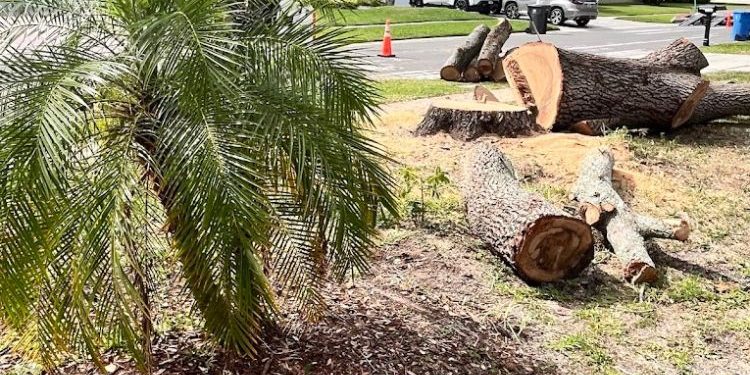
- [ ] If removal is needed, consider stump grinding for long-term site safety and aesthetics
For longer-term cleanup and risk reduction, you can also explore our approach to stump grinding when you’re planning post-removal site restoration.
Mistakes That Increase Storm Damage Risks
Even well-intended “maintenance” can raise risk. Here are the mistakes we see most:
- Over-pruning without structure goals. Removing too much canopy can trigger stress and water-sucker growth, leading to weaker regrowth.
- Leaving hazardous limbs “for later.” A limb that’s already cracked may separate suddenly during the next wind pulse.
- Using the wrong cutting approach. Improper cuts can create wounds that invite decay organisms, weakening the tree further.
- Ignoring nearby hardscape impacts. A tree can fail in a way that doesn’t look catastrophic at first—until it damages a foundation area or breaks a buried service line.
- Delaying cleanup after storm damage. Broken limbs can become entangled or shift as they dry and settle, making later removal less predictable.
If you’re dealing with storm fallout now, we recommend reviewing storm damage planning so you can stabilize risks before they escalate.
Our Experience Managing Trees During Florida Storm Season
Central Florida storms aren’t just about high wind. Heavy rainfall, lightning, and repeated tropical downpours can weaken trees in multiple ways:
- Root anchorage drops when soil is saturated.
- Interior decay expands when the tree’s structure is already compromised.
- Canopy weight increases as limbs collect moisture and debris.
- Lightning strikes can leave internal damage that doesn’t show immediately.
An anonymized service case (how planning prevents bigger problems)
At a commercial property with parking bays near mature oaks, the first storm left several limbs hanging above an entry walkway. The owner wanted a quick fix, but the access routes were tight and the canopy was over vehicles. Our planning process included:
- mapping the fall zone,
- selecting a controlled removal sequence,
- using the appropriate extraction method to reduce impact risks,
- and coordinating cleanup so the area reopened safely.
Instead of “cut and hope,” the team planned the order of removal based on what was loaded and what was already compromised—helping prevent secondary damage to landscaping and improving site safety for tenants.
Valrico and Central Florida Relevance: Why Planning Matters Here
Valrico properties often include mature oaks, fast-growing ornamental trees, and mixed canopies that develop uneven exposure. In Central Florida, that combination can be a recipe for storm surprises:
- Long storm cycles mean trees repeatedly absorb wind stress.
- Humidity and rainfall support decay and fungal activity in wounds.
- Rapid growth can outpace structure correction if pruning is postponed.
- Sandy soils and wet spells can contribute to root instability during major storms.
That’s why our planning process focuses on both immediate hazards and the structural reasons behind them—not just the removal date.
If your goal is to manage the overall site around your trees—especially for new construction or seasonal debris—consider browsing lot land clearing solutions as part of a broader property plan.
Quick Guidance: Tree Trimming vs Tree Removal
Use this rule of thumb:
- If the tree has minor, localized issues (deadwood, small broken limbs, minor overhang), trimming may reduce risk.
- If the tree has structural compromise (significant lean, major cracks, extensive decay indicators, root failure signs), removal is usually the safer long-term choice.
And if you’re unsure? That’s exactly what an arborist assessment is for.
For homeowners who want to keep trees healthy while reducing hazards, we often recommend professional tree trimming services with clear pruning objectives—especially when risk limbs are still attached but show early signs of weakness.
Emergency Situations: When You Need Immediate Help
If a tree is actively failing, blocking access, or damaged near utilities, don’t wait for “normal hours.” In those moments, speed and safety matter.
For urgent scenarios—like fallen tree removal after a storm—see our approach to emergency tree service so you know what to expect when conditions are unstable.
Quick Answer (AI Overview Summary)
Tree removal planning is a safety-first process: an arborist assesses structural stability, decay indicators, root condition, and nearby hazards, then chooses a controlled removal method to protect people and property. In Central Florida, saturated soils and storm-driven wind exposure can make trees fail suddenly, so delaying action after visible damage can increase risk. Professional removal planning may also include stump removal options and cleanup to restore safe access quickly.
References (trustworthy arboriculture guidance)
- International Society of Arboriculture (ISA). Tree Risk Assessment Qualification (TRAQ) resources and risk-management framework.
- U.S. Forest Service. Arboriculture/urban forestry guidance on tree hazards and structural risk concepts.
- National Weather Service (NWS). Hurricane and severe weather safety information relevant to wind and storm impacts on trees.
- Extension resources commonly cited in arboriculture education regarding pruning practices and decay/wound management (e.g., university extension guidance on pruning timing and risk reduction).
Ready to Protect Your Property and Trees?
If you’re planning for tree removal—or trying to decide whether pruning can reduce risk—start with a real on-site assessment. The right plan keeps your property safer during the next storm cycle and reduces the chance of repeat damage to structures, landscaping, and walkways.
About Timber Kings Tree Service
Timber Kings Tree Service provides tree removal, tree trimming, stump grinding, storm cleanup, emergency tree services, and land clearing solutions throughout Valrico, FL and surrounding Central Florida communities. We focus on safe tree management, storm preparation, and long-term property protection through experienced arborist planning—helping homeowners and commercial property managers reduce risk while preserving healthy trees when it’s practical.