When you look at the largest tree on your property, do you feel confident it will stay standing through the next Florida thunderstorm, or do you quietly worry every time the wind picks up? Hazardous trees are one of those risks homeowners in Valrico often underestimate—until a heavy limb crashes onto a roof, a driveway is blocked, or a storm sends a compromised trunk toppling toward the street. Tree removal services for hazardous trees are not just about cutting something down; they’re about managing serious safety risks with skill, planning, and the right equipment.
In a place like Valrico, FL, where mature oaks, pines, and ornamental trees are part of the landscape, knowing when a tree has crossed the line from “beautiful shade” to “serious hazard” can be tricky. That’s where professional services like Timber Kings Tree Service come in. Trained arborists and experienced crews know how to read the warning signs that most property owners miss: subtle trunk cracks, internal decay, root plate movement, or structural defects in the canopy. When removal is the safest option, they handle the entire process in a controlled, methodical way that protects people, property, and surrounding trees.
Tree removal for hazardous trees is not a one-size-fits-all job. Every tree has a unique structure, location, and risk profile. A dead pine leaning over a power line requires a completely different approach than a diseased live oak crowding your roof. Understanding how professionals assess, plan, and execute hazardous tree removals can help you make smarter decisions about your property and know when it’s time to call in Timber Kings Tree Service instead of trying to tackle a dangerous situation yourself.
What Makes A Tree Hazardous
Not every imperfect tree is a hazardous tree. A hazardous tree is one that has a defect or condition that increases the likelihood of failure, combined with a “target” underneath—people, vehicles, structures, or utilities that could be hit if the tree or a large part of it falls. In Valrico, many of these hazards develop slowly over time, often going unnoticed until damage is already done. Common causes include decay from fungi, insect infestations, storm damage, poor pruning practices, and root problems from construction or soil compaction.
One major red flag is structural instability. This can show up as significant leaning, especially if the lean has recently changed, or as large cracks where major limbs connect to the trunk. Multiple trunks with tight V-shaped connections are also prone to splitting, particularly in strong winds. Timber Kings Tree Service crews are trained to spot these structural issues during an inspection and determine if they can be mitigated through pruning or cabling—or if the safest choice is full removal.
Root issues are another critical factor that property owners often overlook. Roots can be damaged by trenching, driveway installation, or even heavy equipment driving repeatedly over the same area. If you notice soil heaving on one side of the tree, exposed roots rotting, or mushrooms growing at the base, the tree’s anchor may be compromised. In Florida’s storm-prone climate, a tree with weakened roots can uproot surprisingly easily, especially in saturated soil. A hazardous root system is one of the most compelling reasons professionals will recommend removal.
Finally, dead or dying trees are almost always hazardous. As wood dries out and decays, it becomes brittle and unpredictable. Large dead branches, known as “widowmakers,” can break off with little warning. A tree that has lost most of its foliage or shows extensive bark loss is no longer a stable structure. Leaving it in place near a home, sidewalk, or play area is a gamble that rarely pays off. Professional tree removal is the most reliable way to eliminate that risk.
Why Professional Removal Matters
It can be tempting to think that cutting down a tree is just a matter of a chainsaw and some effort, but hazardous tree removal is one of the most dangerous jobs in the green industry. The combination of height, weight, unpredictable wood behavior, and proximity to homes and power lines creates a high-risk environment. Professional crews like those at Timber Kings Tree Service bring not only experience but also specialized equipment and safety protocols designed specifically for these situations.
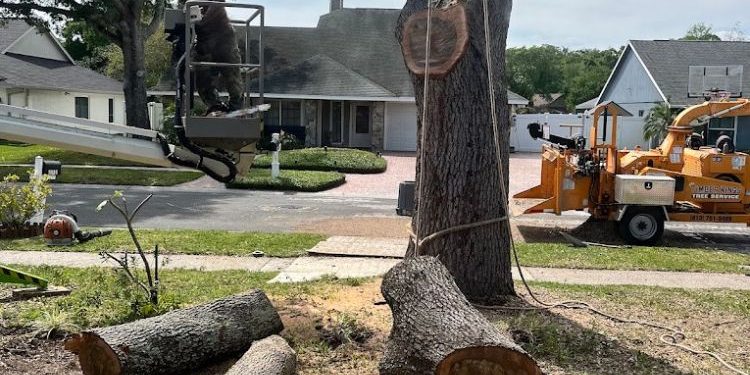
One key advantage of professional removal is controlled dismantling. Instead of simply felling a tree in one direction and hoping it lands safely, experts often take the tree down in sections. Climbers or bucket trucks are used to reach the upper canopy, where limbs are carefully cut and lowered with ropes. This approach is essential in tight residential lots in Valrico, where trees often stand close to houses, fences, pools, and neighbors’ properties. Each cut is planned so that gravity and rigging work together, not against the crew.
Another important element is risk assessment and liability. A reputable company carries insurance that protects both the crew and the homeowner in case of an accident. They understand how to work around energized power lines, fragile roofs, and underground utilities. Homeowners attempting DIY removal often underestimate how far a tree can kick back when it hits the ground, or how a partially cut branch can swing unpredictably. Professional tree removal minimizes these unknowns through training, planning, and the right tools.
Finally, professionals understand how to protect the rest of your landscape during removal. Heavy equipment and falling debris can easily damage lawns, irrigation systems, and other plants if the job is rushed or poorly planned. Timber Kings Tree Service crews use mats, strategic drop zones, and careful rigging to limit collateral damage. When the job is done, they can also handle debris removal, stump grinding, and site cleanup, leaving your property safer and ready for whatever comes next.
The Hazard Assessment Process
Before any hazardous tree is removed, a thorough assessment should take place. This is not just a quick glance from the driveway. A professional will typically walk around the tree, examine it from multiple angles, and look both up into the canopy and down at the root zone. They are evaluating the tree’s overall health, structural integrity, and the potential targets that would be impacted if failure occurs. In Valrico, this might include nearby homes, parked vehicles, children’s play areas, or busy streets.
During the assessment, the arborist may use tools like binoculars to inspect high branches, a mallet to sound the trunk for hollow areas, or a probe to check for internal decay. They’ll look for signs of fungal growth, insect galleries, bark separation, and previous storm damage. Lean, crown asymmetry, and large dead limbs are all noted. The goal is to determine not just if the tree is hazardous, but how urgent the situation is and whether any alternatives to removal exist.
Context is also crucial. A tree with moderate defects in an open field may not be considered hazardous, because there are no targets in the fall zone. The same tree next to a bedroom window or over a driveway could be classified as a high-priority removal. Timber Kings Tree Service considers how frequently people or property are present under the tree—what professionals call “target occupancy.” A sidewalk used daily by schoolchildren, for example, raises the risk level significantly.
Once the assessment is complete, the professional will explain their findings in clear terms. They may recommend immediate removal, scheduled removal within a certain timeframe, or in some cases, risk mitigation through pruning, cabling, or bracing. For many homeowners, this explanation is an eye-opener, revealing hidden problems that were not obvious from the ground. Having a detailed hazard assessment gives you the information you need to make a confident decision about your tree.
How Hazardous Tree Removal Works
After the decision is made to remove a hazardous tree, the process moves into planning and execution. The first step is to determine the safest method for taking the tree down. In some rare cases, if there is plenty of open space and the tree is structurally sound enough, a traditional directional felling cut may be used. However, in most residential areas of Valrico, removal is done through sectional dismantling, where the tree is taken apart piece by piece.
The crew will establish a work zone, often using cones, caution tape, or signage to keep bystanders at a safe distance. They identify drop zones for branches and trunk sections and set up rigging systems if needed. Climbers or bucket operators move into position, secured with harnesses and ropes. Each cut is made with an understanding of how the piece will move once it is free—whether it will be lowered on a rope, swung into a safe area, or allowed to fall into a designated zone.
For particularly hazardous trees, such as those that are dead, severely decayed, or entangled in power lines, additional precautions are taken. Dead wood can break unexpectedly under a climber’s weight, so bucket trucks or cranes may be used instead of climbing. Coordination with utility companies may be required if lines are involved. Timber Kings Tree Service has experience adapting their approach to these complex situations, prioritizing crew safety and property protection above all else.
Once the canopy is removed, the trunk is taken down in manageable sections. These heavy rounds are either dropped in a controlled manner or lowered with ropes. After the tree is on the ground, it is cut into smaller pieces for removal or processing. Stump grinding is often the final step, eliminating the remaining stump below ground level so the area can be re-landscaped, sodded, or simply left safe and level.
Common Hazard Trees In Valrico
Valrico’s tree population includes a mix of native and ornamental species, each with its own strengths and vulnerabilities. Live oaks, for example, are generally strong and long-lived, but they can develop hazardous conditions if improperly pruned, topped, or subjected to root damage. Heavy lateral limbs extending over roofs or driveways can fail under the weight of dense foliage or trapped water in a storm. Internal decay can also develop in large branch unions, turning what appears to be a solid limb into a hidden risk.
Pines are another frequent source of concern. Tall, slender pines with shallow root systems can be especially vulnerable in high winds, particularly if the soil is saturated. Signs of a hazardous pine include excessive leaning, loss of needles in the upper crown, or visible trunk damage from lightning or previous storms. Once a pine begins to decline, it can deteriorate quickly, and the tall, straight trunk can cause significant damage if it falls in one piece.
Ornamental trees such as laurel oaks, maples, and various flowering species can also become hazardous, especially if they’ve been planted too close to structures or allowed to grow without proper structural pruning. Multiple leaders, narrow branch angles, and dense canopies can create weak points where the tree is more likely to split. In some cases, strategic pruning can reduce risk, but when decay or major structural flaws are present, removal is often the most responsible choice.
Storm history plays a big role too. Trees that have survived past hurricanes or severe thunderstorms may have hidden cracks or internal damage. A limb that partially failed and “healed” may still be structurally compromised. Timber Kings Tree Service understands how Valrico’s weather patterns affect local trees and uses that knowledge to identify which trees are most likely to become future hazards.
Preventing Future Tree Hazards
While hazardous tree removal is sometimes unavoidable, many future hazards can be prevented with proactive care. Regular inspections by a qualified tree professional can catch small problems before they become big ones. Early signs of disease, insect activity, or structural weakness can often be addressed through pruning, soil improvement, or other treatments. For homeowners in Valrico, scheduling periodic evaluations is a smart way to protect both your property and your trees.
Proper pruning, especially when trees are young, is one of the most effective preventative measures. Removing weak, crossing, or co-dominant branches early helps create a strong, stable structure that is less likely to fail as the tree grows larger. Avoiding harmful practices like topping is crucial; topping not only disfigures the tree but also creates weakly attached regrowth that is much more prone to breakage in storms.
Protecting the root zone is equally important. Avoid piling soil or mulch against the trunk, driving heavy vehicles over the root area, or cutting roots for construction without professional guidance. Healthy roots anchor the tree and supply it with water and nutrients; once they are compromised, the risk of failure increases dramatically. Timber Kings Tree Service can advise on proper mulching, watering, and protection strategies tailored to the sandy, sometimes compacted soils common in Valrico.
Finally, planning before planting can reduce future removal needs. Choosing the right species for the right location—considering mature size, root spread, and wind resistance—can prevent conflicts with roofs, power lines, and sidewalks down the road. While hazardous tree removal is sometimes the only option, thoughtful tree care and planning can significantly reduce how often you face that difficult decision.
Frequently Asked Questions
How do I know if my tree is hazardous and needs removal? Warning signs include significant leaning that has recently worsened, large dead branches, cracks in the trunk or major limbs, mushrooms or decay at the base, and visible root damage or soil heaving. If the tree is near a house, driveway, play area, or power line, these defects become much more serious. The best way to know for sure is to have a professional from Timber Kings Tree Service inspect the tree. They can evaluate both the tree’s condition and what could be damaged if it fails, then recommend whether removal or another solution is appropriate.
Is it safe to remove a hazardous tree myself? In most cases, no. Hazardous trees are unpredictable, especially if they are dead, decayed, or storm-damaged. Branches can break unexpectedly, trunks can twist or kick back as they fall, and nearby structures or power lines add complexity. Homeowners typically lack the training, rigging equipment, and protective gear needed to manage these risks. Professional crews are trained to anticipate how the tree will behave, control the direction of falling pieces, and protect both people and property throughout the process.
What does hazardous tree removal usually include? A standard hazardous tree removal service typically includes an initial assessment, a detailed removal plan, controlled dismantling of the tree, and cleanup of the branches and trunk wood. Many homeowners in Valrico also choose to have the stump ground down so the area can be reused. Timber Kings Tree Service can discuss options such as leaving some wood for firewood, hauling away all debris, or preparing the area for replanting. The exact scope can be tailored to your needs and budget.
How quickly should a hazardous tree be removed? The urgency depends on the severity of the defects and what is at risk beneath the tree. A severely decayed tree leaning over a home, driveway, or busy street may require prompt attention, especially during storm season. Other trees with moderate issues but lower target occupancy may be scheduled within a reasonable timeframe. Once a professional identifies a tree as high-risk, it is wise to act sooner rather than later, as additional storms or heavy winds can accelerate failure.
Do you offer emergency hazardous tree removal in Valrico? When a tree or large limb has already failed or is about to fail, emergency service becomes crucial. Timber Kings Tree Service provides rapid response for storm-damaged and imminently dangerous trees in Valrico and nearby areas. In urgent situations, you can reach out for Emergency Tree Service to address blocked driveways, trees on structures, or dangerously hanging limbs. Prompt professional help can prevent further damage and restore safety to your property as quickly as possible.